
eBooks
100 Books found- Featured
Ensaio sobre a inconstitucionalidade das leis no direito português
Authors: Tello de Magalhães Collaço, João Maria
Hey, so I just finished this surprisingly gripping book about Portuguese law. I know, I know—it sounds like homework. But here's the thing: it's about the ultimate power struggle. Who gets to say a law is wrong? Is it the courts? The government? The people? The author, Tello de Magalhães Collaço, digs into a real-life legal drama that shaped modern Portugal. It's less about dusty statutes and more about a fundamental question of justice and who holds the keys. If you've ever wondered how a country decides its own rules are broken, this is a fascinating and surprisingly accessible look behind the curtain.
- Featured
Der Landprediger by Jakob Michael Reinhold Lenz
Authors: Lenz, Jakob Michael Reinhold, 1751-1792
Have you ever felt stuck in a life you didn't choose? That's the heart of 'Der Landprediger' (The Village Pastor). We meet a young pastor, full of modern ideas and energy, who gets sent to a sleepy, traditional village. He wants to shake things up, to help people think in new ways. But the village? They like things just as they are. This book is a quiet, sometimes funny, sometimes heartbreaking look at the clash between one person's passion for change and a whole community's comfort with the old ways. It's less about dramatic battles and more about the slow, daily grind of good intentions hitting a wall. If you've ever tried to fix something and met resistance at every turn, you'll see yourself in this pastor's struggle.
- Featured
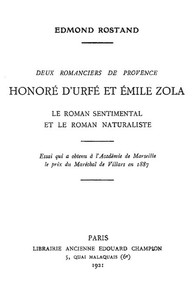
Deux romanciers de Provence: Honoré d'Urfé et Émile Zola by Edmond Rostand
Authors: Rostand, Edmond, 1868-1918
Ever wonder what happens when you put two literary giants from completely different eras in the same room? Edmond Rostand, the man behind 'Cyrano de Bergerac,' does exactly that in this quirky little book. It’s not a novel, but a playful, imagined conversation between Honoré d'Urfé, the 17th-century author of a sprawling pastoral romance, and Émile Zola, the 19th-century master of gritty naturalism. The magic is in the clash: think flowery shepherds and chivalric love versus coal mines and social injustice. Rostand acts as the witty host, setting them up to debate the very soul of storytelling. It's a short, clever, and surprisingly fun look at why we write and what we think literature should do.
- Featured
La araña negra, t. 9/9 by Vicente Blasco Ibáñez
Authors: Blasco Ibáñez, Vicente, 1867-1928
Okay, so you know how most book series build up to a big finale? This ninth and final volume of 'La araña negra' is that payoff, and it's intense. We're diving headfirst into the climax of a story that's been weaving together social unrest, dark secrets, and a mysterious, shadowy organization. If you've been following along, this is where all those threads get pulled tight. If you're new, it's a masterclass in how to finish a sprawling historical drama with guts and heart. Blasco Ibáñez doesn't hold back here. Get ready for some serious drama, unexpected twists, and a conclusion that will stick with you. Trust me, it's worth the journey.
- Featured
Considerations on Representative Government by John Stuart Mill
Authors: Mill, John Stuart, 1806-1873
Ever wonder why some democracies feel broken? John Stuart Mill asked that same question back in 1861, and his answers are shockingly relevant today. This isn't a dry political manual—it's a passionate argument about what makes a government truly good for its people. Mill wrestles with the big stuff: How do we balance smart leadership with what the public wants? Can regular people be trusted with power? If you've ever felt frustrated with politics or wondered if there's a better way to run things, this classic will give you a whole new framework to think about it. It’s like having a brilliant, slightly intense friend explain the machinery of democracy.
- Featured
Cats: Their Points and Characteristics by Gordon Stables
Authors: Stables, Gordon, 1840-1910
Hey, have you ever wondered what your cat is *really* thinking? Or why that aloof Persian looks down on the world? I just read this fascinating, slightly bonkers book from the 1800s that tries to answer all that. 'Cats: Their Points and Characteristics' is less a dry manual and more like having a chat with a wildly enthusiastic, sometimes grumpy Victorian gentleman who has very strong opinions about cat whiskers and moral character. It's a charming, often funny time capsule that reveals just as much about the people of the past as it does about their feline companions. If you love cats and a bit of history, you'll get a real kick out of this.
- Featured
Impresiones, Poesías by José Campo Arana
Authors: Campo Arana, José, 1847-1885
Ever wondered what it was like to be a poet in 19th-century Spain, caught between tradition and the modern world? That's the quiet, powerful question at the heart of José Campo Arana's 'Impresiones, Poesías'. This isn't just a collection of pretty verses. It's the record of a sensitive soul observing a society in flux—the fading grandeur of old Spain, the whispers of change, and the personal loneliness that comes with being an observer. Reading it feels like finding a forgotten diary, full of beauty and a subtle, persistent melancholy. If you love poetry that feels both historical and deeply human, this is a hidden gem waiting for you.
- Featured
The Silversmith's Handbook by George E. Gee
Authors: Gee, George E. (George Edward)
Hey, have you heard about this fascinating old book I found? It's called 'The Silversmith's Handbook' by George E. Gee, and it's not a novel at all—it's a genuine guide from 1908 on how to actually *be* a silversmith. Think of it as a time capsule. You get step-by-step instructions on everything from setting up your workshop to intricate engraving techniques, all written when this was a common trade. The real magic isn't in a fictional plot, but in the mystery of a lost art. It makes you wonder about the countless hands that used these very instructions to create beautiful, lasting objects. If you've ever been curious about how things were really made before mass production, this is a surprisingly engaging peek behind the curtain.
- Featured
La fille du capitaine by Aleksandr Sergeevich Pushkin
Authors: Pushkin, Aleksandr Sergeevich, 1799-1837
Have you ever thought about what you'd do if the person you loved was on the 'wrong side' of a rebellion? That's the heart-pounding question at the center of Pushkin's 'The Captain's Daughter.' It's not just a dusty old Russian classic. It's a swift, romantic adventure set during a violent peasant uprising. Our hero, Pyotr, is sent to a remote military outpost, falls for the commander's daughter, Masha, and then has to navigate loyalty, honor, and survival when a rebel leader storms the fortress. It’s a story about love in impossible times, and the choices that define us. You’ll race through it.